
Satisfaction Surveys Boost Retention at Senior Facilities
Senior facilities that measure (and act on) resident satisfaction surveys have higher levels of retention.
The resulting higher satisfaction is clearly linked to longer length of stay and lower move-out rates. An NORC study that followed thousands of older adults across senior living settings found that residents report higher family trust and improved retention as key outcomes, and that health stability, extended lifespan, and better quality of life were all associated with senior living communities that prioritized the resident experience and continually improved it through measurement.
The industry's experience with the J.D. Power satisfaction data over many years reinforces this. With average costs of assisted living and memory care rising 10% year-over-year and independent living rents rising 7–9%, it might seem surprising that satisfaction rose alongside those increases — yet J.D. Power's 2025 study found satisfaction with assisted living and memory care up 12 points and independent living up 25 points. That combination — rising costs, rising satisfaction, stable occupancy — mirrors the pattern seen in apartment research: satisfied residents absorb increases rather than leave. The satisfaction was measured and monitored through resident surveys.
The explicit framing — satisfaction as a performance driver — reflects an industry consensus that dissatisfied residents move out, and that move-outs are costly both financially and reputationally.
Minnesota has gone so far as to add new quality ratings based on state health department surveys to its Assisted Living Report Card, with ratings updated quarterly — reflecting the regulatory community's growing view that satisfaction measurement is inseparable from quality outcomes, including retention.
Activated Insights, which serves over 16,000 senior care sites, explicitly positions its experience management platform as a tool to catch turnover risks and satisfaction gaps before they escalate, with the stated goal of reducing turnover, improving engagement, and turning resident feedback into a competitive advantage. The platform's adoption at that scale reflects an industry belief — backed by operator experience — that surveying drives retention.
The CAHPS Nursing Home Survey program, developed by AHRQ at the request of CMS, was built on the premise that resident and family experience data predicts quality outcomes — and CMS has incorporated it into the Five-Star rating system precisely because experience scores correlate with clinical quality, staffing stability, and by extension, length of stay. Facilities with higher CAHPS scores tend to have lower rates of avoidable hospitalizations and emergency transitions — both of which are proxies for resident stability and retention.
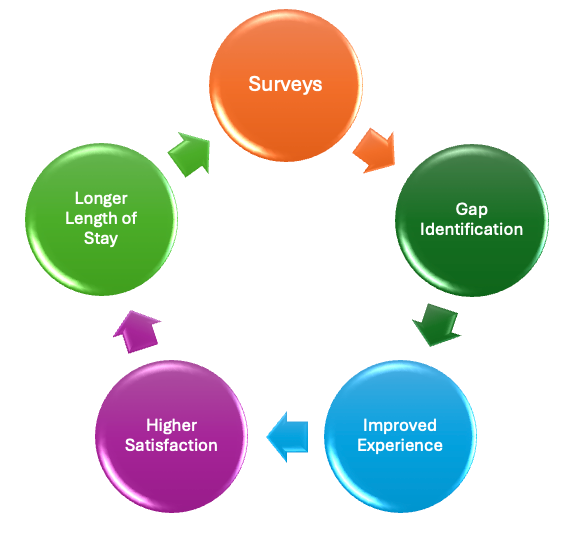
Evidence suggests this flow of events:
The Bottom Line: Surveys Can Improve Retention
The evidence chain is strong and industry consensus is clear: senior care facilities that measure resident satisfaction and use the data to improve operations achieve higher satisfaction scores, and higher satisfaction scores are directly associated with longer length of stay and lower move-out rates.
The industry has moved well beyond treating satisfaction as a soft metric — it is now viewed as a leading indicator of occupancy, census stability, and financial performance. The facilities that rank highest in third-party satisfaction studies year after year are the same facilities that have built systematic, ongoing resident feedback programs into their operations.